
It’s Time to Get Rid of All Those Useless Cables and Connectors
During the last couple of decades, we have made excellent progress in standardising the number of cables and connectors needed for our devices.

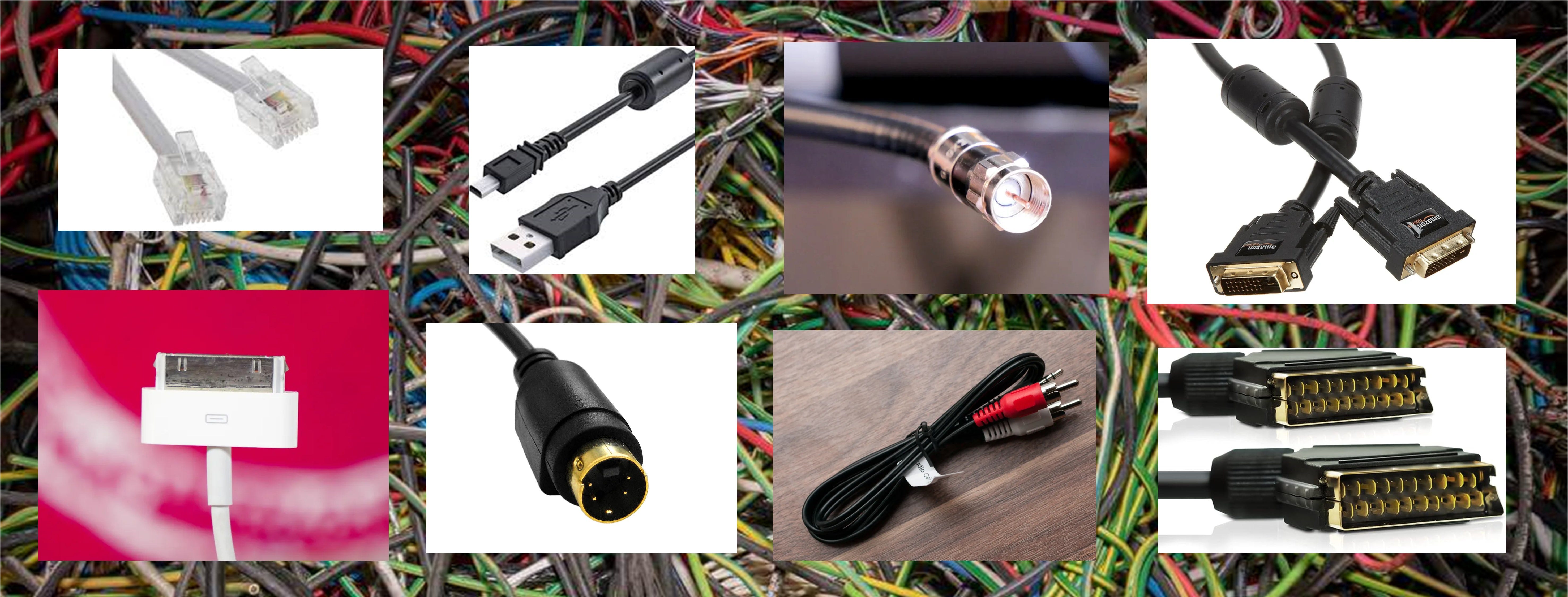
Not long ago, I got rid of a large collection of electronic and computer cables which, I don’t believe, will ever be needed again. However, it wasn’t all that easy for me to do because I’m one of those people who tend to keep things if they are needed for some obscure reason sometime in the future. Seldom does this ever happen and it got to be the point that I was drowning in boxes of useless things taking up valuable space.
Such is the case of electronic and computer cables. The interesting thing is that during the last ten years or so, we have massively simplified the way we need to wire things up in the world of electronics and computers. Our technology is getting more advanced every single passing day; however, we are finally making progress in the world of standardising the way we connect things up.
Naturally, our wireless world has made the way we connect our devices even more simple by not having any wires at all, but we can’t avoid wired technology just yet, especially when robustness, security, and power delivery is required. For example, we still need chargers to keep our devices working and fibre optic cables to deliver our most secure and high-speed connections. Elon Musk’s Starlink is certainly impressive bringing high-speed satellite Internet along with real competitive prices for the consumer is amazing, but we still need those hard-wired trunk routes connecting our continents together under the sea. At least for now.
From my earlier years during the 80s leading up to around the early 2010s, the variety of different types of cables and connectors has been utterly staggering and sometimes incredibly bewildering. Many of us who herald the days of simplicity decades ago may be right in some respects, but not with cables and connectors. It was an utter nightmare for consumers and engineers, of which, I was one in the world of network and mobile phone engineering. I had accumulated so many weird, obscure, and bizarre cables, that now, I look at them and wonder whatever were they used for and why did they have to build them this way.
Let’s start with some common cables which we all used to have but now seem utterly outdated and useless.
I’m going to start with my most hated of all cables. The fat, unwieldy, and awkward SCART cable. Remember these? The connector is a sort of rectangular-like 21-pin monster which you had to wriggle and fight to get into the back of a VCR, TV or home cinema projector. Good quality SCART cables were expensive and had cables the diameters of garden hoses and they were usually stiff and unwieldy. I had such a beast in my collection. It measured ten metres and weighed something like five kilograms.
But there was a myriad of other ways to connect video components back in those days. The most common of all was the humble RCA plug, the plug which is still often used today for connecting audio components in the consumer market, the right audio channel being coloured red and the left channel being white. On video equipment, the plug was marked yellow for low-grade composite video, but these days, it is generally obsolete because our video quality has got so much better. Superior quality for video could be had by connecting three cables instead of one using RCA plugs, each one split into three video channels. Known as component video, it delivered far better quality, but today, it is still unwieldy and needed two additional sockets which take up valuable real estate space on electronic devices. Therefore, to get audio and video, you needed a grand total of five cables terminated with RCA plugs or one of those unwieldy SCART cables.
There was also the sleeker and smaller super video, or S-Video, cable which sported a much smaller rounder looking socket. It replaced the single and horrible standard composite RCA cable, but it was not as good as the three-cable component video option. These video connections became near obsolete when HDMI and DisplayPort cables came into existence. Almost any modern video appliance uses HDMI these days and all modern computer monitors has both DisplayPort and HDMI connectors. The only thing that complicates the choice is that there are smaller mini versions for both these connectors, but, thankfully, we have, at least one go-to video cable, the near universal HDMI cable, which also supports audio as well.
The worst culprit for making cabling nightmarish for all is when manufacturers can’t decide what connectors to use, and instead, make their own proprietary ones. Especially in the world of charging stations and cables. My deteriorating eyesight has made it difficult to distinguish between the seemingly dozens of different mini and micro-USB-type connectors, many of which look like each other without the aid of glasses or an electron microscope. I tried connecting an old Nikon compact camera with one of those standard USB-A to mini-USB-A cables. But alas, it didn’t fit because Nikon decided that using a standard mini-USB-A plug wouldn’t suffice and adopted a similar looking plug which none of my other devices used. I had to order this cable from Amazon because I had lost it.
Apple, at long last, is now adopting, what I consider, one of the most successful and universal of all connectors, the simple USB-C connector. An elegant sleek flat oval mini connection which works any which way you plug it in. Gone were those hideous iPhone 30-pin connectors of old which used to clog up and fail. And finally, we are moving away from Apple’s greedy copyrighted lightning connector, which cost the consumer nearly ten times more to buy than the humble USB-C connector. Apple may not be happy with this, but I remember the extraordinary move by the EU to force apple to adopt USB-C on ground of making it easier for the consumer and also to reduce waste.
As for hard-wired data network transmission, we have one particularly useful cable which has been generally unchanged through the decades and, no doubt, with little change in the foreseeable future. The universal Cat6 ethernet cable complete with the most common of all data connections, the RJ45 plug. I always carry one around whilst travelling just in case, but with wireless technology, I seldom need it. With so few of us now having hard telephone lines to our houses, we have vastly reduced the need to have those thin telephone cables with the similar but smaller RJ11 connectors, which many people confuse with the RJ45 connector used for ethernet cables. The only time we tend to need them is to connect our modems to our Internet service, but even now, with fibre connections being delivered to people’s home directly, this is quickly becoming obsolete.
As for analogue TV being nearly wiped out by digital services, the need to have an armoury of coaxial cables, antennas, and other fiddly and fickle devices like signal amplifiers is nearly non-existent. Many remote rural communities have digital services through the air and, going back to the subject of satellite, we have an affordable option with Starlink. Of course, there are those radio hobbyists who still enjoy the nostalgia of short-wave radio, but this is a specialist crowd.
Now, I am focussing on general consumer products because, in the world of commercial electronics and communications, which I used to work in, there is still a need to have specialised cables and connections. But by and large, as a consumer, we only need to carry a minimum number of cables and connectors for everyday use. For example, as a traveller, why do I really need anything more than a USB-A to USB-C and an HDMI cable? Sadly, I still need to carry a lightning cable with me for my iPad, but I hope that will change soon.
Seriously, we don’t need manufacturers creating more weird and exotic connections for stuff that will eventually be phased out by newer and better models. For quite some time, when I choose an electronic item, especially in the world of digital cameras, I avoid buying from manufacturers which have their own proprietary connections. They’re a bloody nuisance.
With all this in mind, there are specialist areas in which the use of generally obsolete cables is sought after. For example, the world of hi-fi audio, a hobby which I am passionate about. I kept all my high-quality audio cables comprising mainly of beautifully handcrafted cables with top-quality RCA connections. I personally believe that the highest quality of audio can be achieved with high-resolution electronic files delivered straight to a high-quality digital-to-analogue converter wirelessly or over an ethernet cable from a good storage device like a NAS drive. However, there are analogue enthusiasts out there who enjoy playing good old vinyl records on a turntable, which, I admit, I enjoy as well. Such equipment requires old-fashioned but high-quality cables and connections. So yes, I’ve kept all my high-quality audio cables.
The world of video editing using a PC has got so much easier than it was back in the early 2000s. I remember doing a lot of video editing back then, but it required some major kit for my PC. I had to buy a separate video card package complete with an extensive set of cables and a conversion device to cater for the complete madness of video compatibility we had to contend with. You couldn’t simply play an analogue video recorded in PAL format, like that in the UK, with a machine that could only play NTSC, the format used in the United States. And there was SECAM as well, which countries like France used. It was bedlam to say the least!
Those days are gone thank goodness!
So, for all who say that technology has got too complicated?
Well. Think again. Just remember all the strange and exotic electronic devices with their own weird and exotic proprietary cables and connectors. Cables that got lost never to be found again rendering the equipment unusable until you find a replacement in the darkest corner of the Internet.
I think we had long ago passed the pinnacle of cable and connection complexity, but we still have some way to go to make our cable management even more simple.